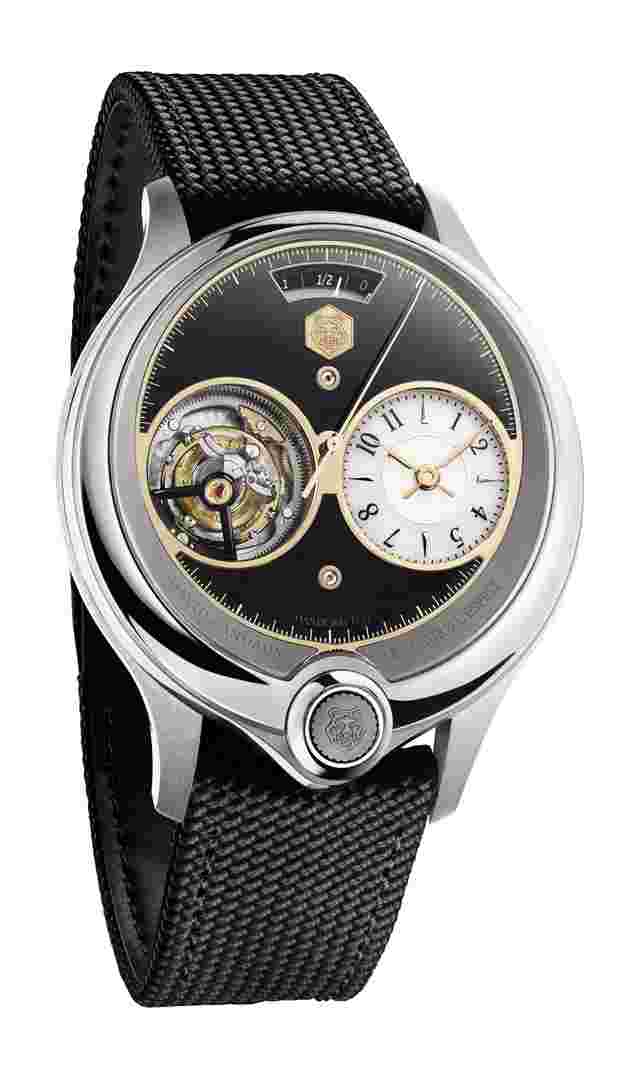

The DC1 First Eight arrived in 2017 as a statement of principles: a flying tourbillon inclined at thirty degrees, a magic crown recessed at six o’clock, an asymmetrical stepped case housing a cascading movement made entirely of natural titanium. That architecture, born in the Solliat workshop, has not changed in the years since. What has changed, for the first time in 2026, is the material. The DC1 Platine Art du Tourbillon brings platinum to David Candaux’s foundational piece, a limited run of eight watches that asks, simply, what density and presence do to a design that was already proven. The answer is considerable. Platinum grips and tears where softer metals yield; it retains the memory of every polishing pass and exposes the slightest imprecision. For a case with edges as taut as those of the DC1, working in platinum means rethinking every sharp angle so that geometry survives the finisher’s wheel. The entire case is polished, and every surface shows it. Beneath the crystal, the dial is a layered construction unique to the brand: mirror-polished black onyx forming the central plate, two-tenths of a millimeter thick, so fragile that five blanks are consumed to complete one, set against a white opal hour and minute dial at three o’clock that shifts from translucent and deep indoors to luminous outdoors. Rose gold flanges in 18-karat gold frame both elements, wrapping around the tourbillon cage at nine o’clock. The magic crown at six reads the same material contrast as the case itself: titanium body, platinum cap. At the heart of everything sits the H74 caliber, developed in-house at Solliat, with Grade 5 titanium bridges, beryllium copper wheels, and a tourbillon cage in black anodized titanium. Its color is achieved through micro-arc oxidation, a ceramic transformation integrated into the metal’s own surface. The thirty-degree inclination of the cage is no affectation. It sweeps through positions a conventionally oriented tourbillon never reaches, including the flat positions critical to chronometric accuracy at rest. David Candaux has said the tourbillon was never meant for the wrist. He built one anyway, then solved for its shortcomings. That tension, between the heart’s decision and the mind’s discipline, is what the DC1 Platine Art du Tourbillon ultimately represents.